
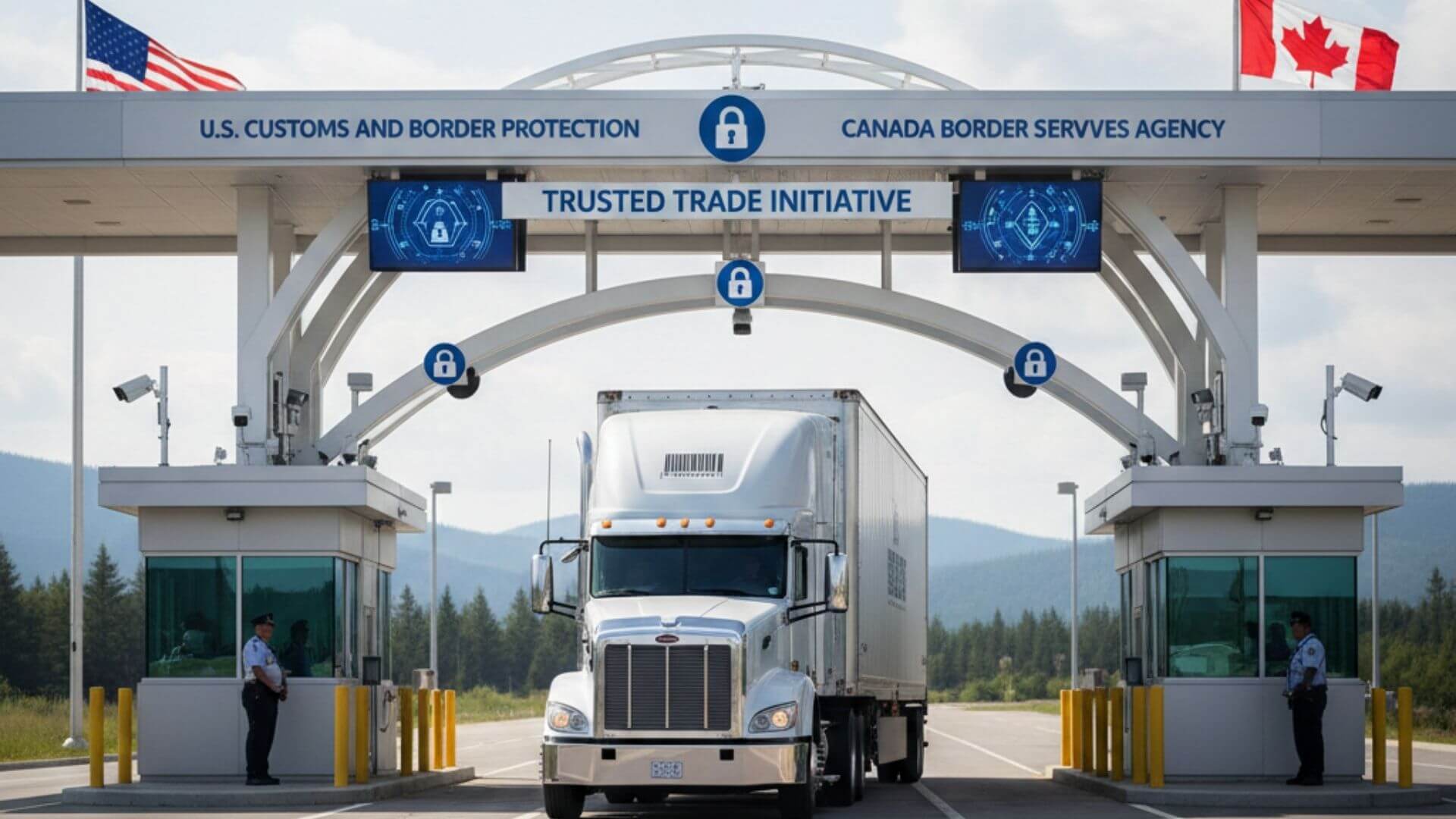
A practical guide for North American logistics and compliance teams to use C‑TPAT as a strategic advantage in supply chain security.
What Is C‑TPAT and Why It Matters Now
C‑TPAT (Customs‑Trade Partnership Against Terrorism) is a voluntary supply chain security program led by U.S. Customs and Border Protection (CBP) that builds trusted partnerships between government and private companies to protect international trade from terrorism and other security threats. By meeting a defined set of security criteria, companies can be recognized as low‑risk partners and receive operational benefits at the border, such as fewer inspections and faster cargo processing.
For logistics and compliance teams operating between the U.S. and Canada, C‑TPAT has become more than a “nice‑to‑have” certification; it is often a deciding factor when importers choose transport and logistics partners. In a context of increasing scrutiny over cargo security, forced labor, and regulatory compliance, C‑TPAT functions as a structured framework to prove that supply chain risk is being managed systematically.
Who C‑TPAT Is For in the U.S. and Canada
C‑TPAT primarily targets companies that have a direct role in the movement of goods entering the United States, including U.S. importers, carriers, consolidators, customs brokers, and certain manufacturers. Eligibility depends on factors such as volume of U.S. trade, role in the supply chain, and willingness to implement and document robust security controls across facilities, processes, and business partners.
Although C‑TPAT is a U.S. program, it has a strong impact on Canadian businesses that trade with the U.S. or integrate into U.S. import supply chains. Canadian companies often align C‑TPAT efforts with Canada’s Partners in Protection (PIP) program, which is designed to harmonize with C‑TPAT and support secure, efficient cross‑border trade between both countries. For a carrier or logistics provider like Transsp, this means that being familiar with C‑TPAT requirements is essential to serve both U.S. and Canadian customers that demand secure and compliant transport solutions.
Where C‑TPAT Applies in the Supply Chain
C‑TPAT applies across the entire international supply chain, focusing on how cargo moves from foreign suppliers to U.S. ports, border crossings, warehouses, and final destinations. The program’s Minimum Security Criteria cover areas such as physical access controls, IT security, personnel security, container integrity, cargo handling, and business partner management.
These requirements impact ports, terminals, distribution centers, truck yards, and any facility where cargo may be stored, consolidated, or transloaded. For cross‑border operations between the U.S. and Canada, C‑TPAT criteria are especially relevant at border crossing points, bonded warehouses, and high‑throughput logistics hubs where security incidents or non‑compliance can result in delays, inspections, and extra costs.
When and Why Companies Should Apply
Companies should consider applying for C‑TPAT certification once they have stable import volumes into the U.S. and a clear view of their supply chain partners and processes. The application process requires documentation of security procedures, risk assessments, and evidence that controls are implemented, monitored, and continuously improved.
From a strategic perspective, the best timing to invest in C‑TPAT is when the company is seeking to expand U.S. trade, win larger import clients, or differentiate from competitors by offering verifiable supply chain security. With growing enforcement around forced labor, data integrity, and cargo security, C‑TPAT participation can also reduce the likelihood of disruptive holds, seizures, or intensive examinations at the border.
Key C‑TPAT Requirements: The Core Checklist
The C‑TPAT requirements checklist is built around Minimum Security Criteria that vary slightly by business type but generally fall into several pillars. Key areas include:
- Corporate security policy and management commitment, demonstrating that security is a recognized strategic priority and not just a checklist exercise.sgs
- Risk assessment processes, ensuring that threats across routes, facilities, and partners are identified, evaluated, and mitigated using documented controls.msrcustoms
- Physical security and access controls, such as fencing, locks, surveillance, visitor management, and ID procedures to prevent unauthorized access to cargo.vizitorapp
- Procedural security, covering how shipments are documented, loaded, sealed, transported, and reconciled to avoid tampering, misrouting, or fraud.nationalsecuritylawfirm
- Information technology and data security, protecting shipment data, customs documentation, and operational systems from unauthorized use or manipulation.siemon
- Personnel security, including background checks, hiring standards, security training, and processes to revoke access for departing employees or contractors.legal.thomsonreuters
- Business partner requirements, requiring companies to vet, monitor, and sometimes require equivalent security standards from suppliers, carriers, and intermediaries.cbsa-asfc
Logistics providers like Transsp can structure internal procedures, driver instructions, yard management rules, and partner onboarding processes around these pillars to build a consistent and auditable security posture.i9ce
Recent Updates: Forced Labor and Trade Compliance
In recent years, C‑TPAT has incorporated stronger elements related to forced labor and trade compliance, aligning with U.S. laws such as the Uyghur Forced Labor Prevention Act (UFLPA). Participants in the C‑TPAT Trade Compliance component are expected to demonstrate robust controls to prevent forced labor in their supply chains, including supplier due diligence, documentation, and escalation procedures when risks are identified.qima+1
These updates mean that C‑TPAT is no longer focused only on physical and cargo security; it now overlaps with ESG, human rights, and ethical sourcing agendas. For companies that serve both U.S. and Canadian customers, this creates an opportunity to integrate forced labor compliance into broader corporate policies that also satisfy Canadian expectations and international best practices.pcbusa+1
C‑TPAT and Canada’s PIP: A North American View
The Canadian Partners in Protection (PIP) program is a similar voluntary security initiative from the Canada Border Services Agency (CBSA) designed to strengthen supply chain security for trade entering or leaving Canada. PIP and C‑TPAT have been progressively harmonized to facilitate “trusted trader” recognition across the U.S.–Canada border, reducing duplicate audits and enabling coordinated benefits.diaztradelaw+1
For a cross‑border carrier or logistics provider, understanding both programs is vital because many large shippers prefer partners that are certified or at least aligned with C‑TPAT and PIP expectations. By designing internal security procedures that satisfy both frameworks, a company like Transsp can market itself as a North American‑ready provider, capable of supporting customers that prioritize secure and compliant trade in both directions.veroot+1
Practical Benefits for Logistics Providers like Transsp
C‑TPAT participation can deliver several practical benefits that directly impact operations and customer perception. Common advantages include reduced cargo inspections, faster release times, access to dedicated lanes or FAST processing at certain border points, and improved communication channels with customs authorities.federalregister+1
Beyond operational speed, C‑TPAT certification signals to the market that the company takes security and compliance seriously, which can help win contracts with multinational importers and manufacturers. For a logistics brand positioning itself in the U.S.–Canada corridor, showcasing C‑TPAT alignment in marketing materials, tender responses, and customer presentations can be a strong differentiator.onswitchboard+1
How to Use the C‑TPAT Checklist Inside Transsp
To translate C‑TPAT theory into daily practice, logistics and compliance teams can use the C‑TPAT requirements checklist as a roadmap for internal projects. Typical steps include:legal.thomsonreuters
- Mapping all facilities, routes, and partners involved in U.S.-bound shipments and assigning security responsibilities to specific roles.msrcustoms
- Conducting a structured risk assessment that rates threats such as cargo theft, tampering, identity fraud, cyber incidents, and forced labor exposure.sgs
- Documenting policies and standard operating procedures that respond to the Minimum Security Criteria and can be shown during validations or audits.nationalsecuritylawfirm
- Training employees, drivers, and subcontractors on key security practices, incident reporting, and their responsibilities under C‑TPAT commitments.vizitorapp
- Monitoring performance and incidents, using KPIs and periodic reviews to adjust controls as operations evolve.i9ce
By treating the checklist as a continuous improvement tool rather than a one‑time project, Transsp can embed C‑TPAT principles into its culture and daily operations.veroot
C‑TPAT is more than a compliance label; it is a comprehensive framework that helps U.S. and Canadian supply chain partners build secure, resilient, and trustworthy logistics networks. For companies like Transsp that operate across the North American corridor, using the C‑TPAT requirements checklist as a strategic tool can unlock operational benefits at the border, strengthen customer relationships, and position the brand as a trusted link in international trade.customscity+1